Stunning visual of the center of the Milky Way in the radio band, courtesy of MeerKAT radio telescope array.

Originally posted on Twitter.
Breaking News & Random Musings on Space, Technology, Sci-Fi & the View From A Writer’s Window
Stunning visual of the center of the Milky Way in the radio band, courtesy of MeerKAT radio telescope array.
Originally posted on Twitter.
4th of July fireworks courtesy of Hubble and the future supernova Eta Carinae: https://www.universetoday.com/142734/hubble-has-a-brand-new-picture-of-the-massive-star-eta-carinae-it-could-detonate-as-a-supernova-any-day-now/
Originally posted on Facebook.
I missed it here in the Northern Hemisphere, but perhaps you caught a glimpse, or a shadow. Photographer Joaquin Baldwin certainly did: “Here is one shot from today’s total solar eclipse in Chile! Amazing spectacle, we picked a risky location using lots of planning and scouting, and it paid off.”
Originally posted on Twitter.
One of the fun(?) aspects of spinning up a new series is giving new names to things. I have found myself in need of an acronym this morning. Without disclosing the purpose of the entity behind the acronym, so far I have such candidates as:
- HUG
- HARD
- CHUMP
- MUSE (I actually like this one 😉)
- CHUG
- LEAP
- LAME
- HUMID
- HALP
...I'm not sure I remember how to do this right.🤔
*
Originally posted on Facebook.
The website got a minor (visual) and fairly major (structural) redesign this week. If poking around webpages, menus and links is your idea of fun - or if you just want to check it out 😁 - feel free to look around and let me know if anything is broken or wonky: https://www.gsjennsen.com.
Visually, the redesign is not as dramatic as the one I did 2 years ago. But it should be (a) easier to navigate, with clear pointers to important information, (b) less overwhelming for newcomers, and (c) perhaps most importantly, look great on mobile devices. Hopefully, all those things are true. 😋
Originally posted on Facebook.
The good kind ;). From the hugely difficult - and - hugely successful - SpaceX Falcon Heavy launch this week, an incredible image by astrophotographer Erik Kuna. In the photographer’s own words: “Cannot believe this happened just above the earth on the edge of the Mesosphere and Thermosphere around 85-120km in altitude yet it looks like something from a deep space Hubble telescope image.”
Initially posted on Twitter.
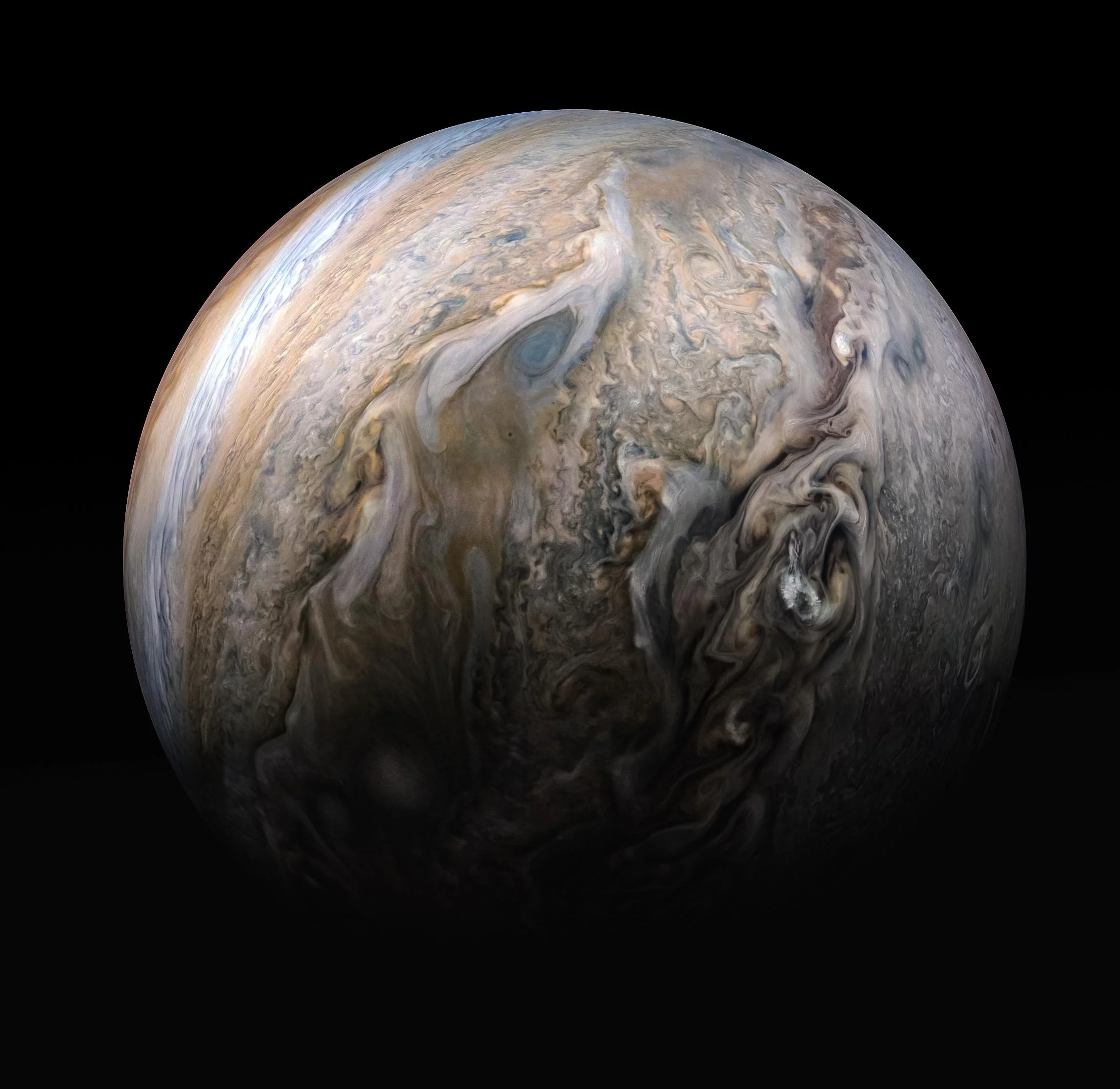
This stunning image of Jupiter's stormy northern hemisphere was captured by NASA's Juno spacecraft as it performed a close pass of the gas giant planet. Some bright-white clouds can be seen popping up to high altitudes on the right side of Jupiter's disk.
Juno took the four images used to produce this color-enhanced view on May 29, 2019, as the spacecraft performed its 20th science pass of Jupiter. At the time the images were taken, the spacecraft was between 11,600 miles (18,600 kilometers) and 5,400 miles (8,600 kilometers) above Jupiter's cloud tops.
https://www.nasa.gov/image-feature/tumultuous-clouds-of-jupiter/
Initially posted on Twitter.
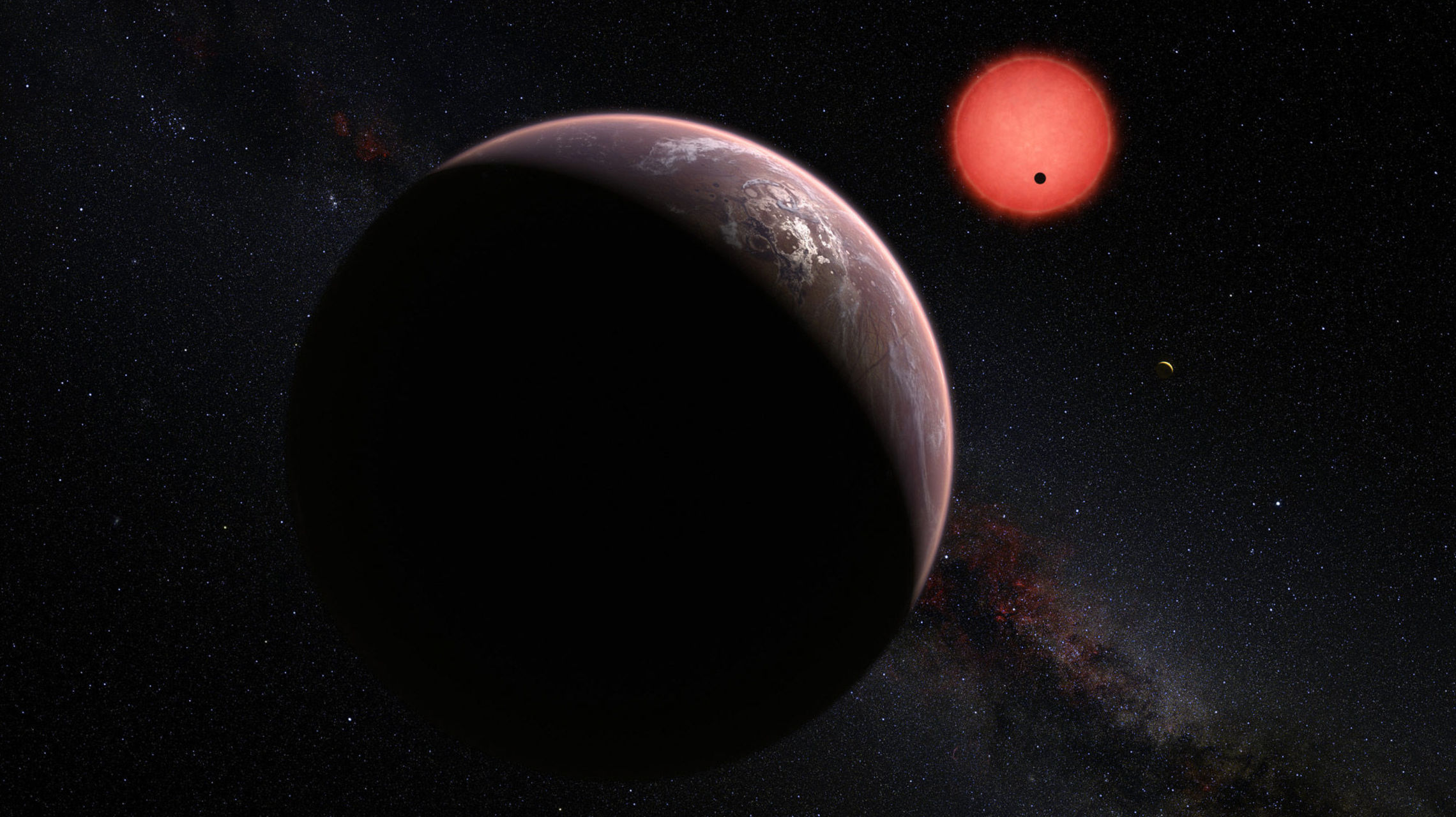
Astronomers have found two Earth-sized and *potentially Earth-like* planets orbiting a star just 12.5 light years away. The planets were found using an instrument called CARMENES, which stands for Calar Alto high-Resolution search for M dwarfs with Exoearths with Near-infrared and optical Échelle Spectrographs). That's a mouthful, but it means an extremely sensitive detector mounted on a telescope at the Calar Alto observatory in Spain that looks for alien worlds like Earth orbiting very cool red dwarfs.
http://edit.syfy.com/syfywire/two-earth-sized-planets-found-in-a-nearby-stars-habitable-zone
Originally posted on Twitter.
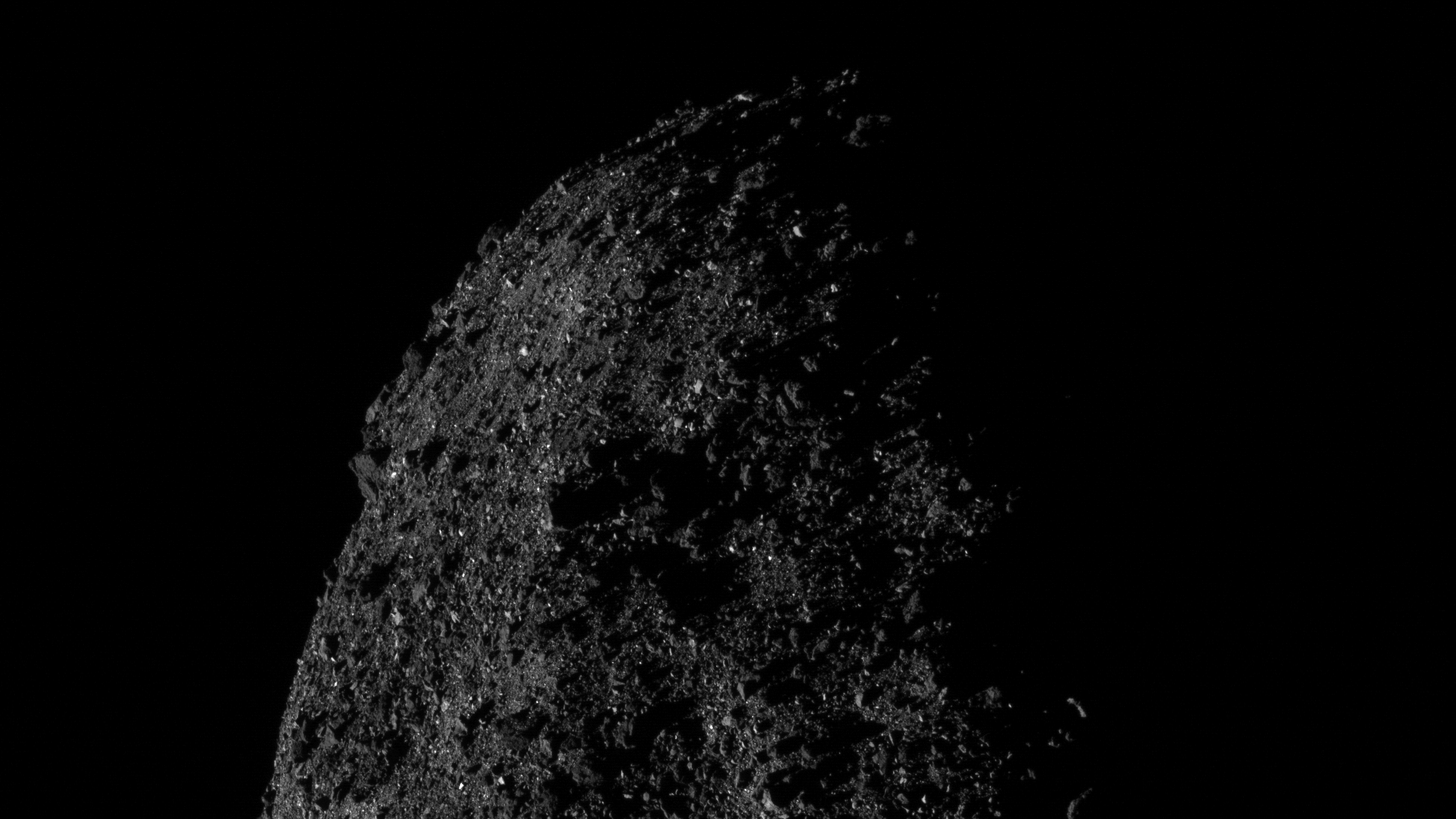
NASA's OSIRIS-REx Spacecraft Takes Stunning Photo of Asteroid Bennu From Just 0.4 Miles Away. This image of asteroid Bennu was captured on Jun. 13, 2019, shortly after NASA’s OSIRIS-REx spacecraft executed its second orbital insertion maneuver. From the spacecraft’s vantage point in orbit, half of Bennu is sunlit and half is in shadow. At this distance, details as small as 1.6 ft (0.5 m) across can be resolved in the center of the image.
https://gizmodo.com/nasas-osiris-rex-spacecraft-takes-stunning-photo-of-ast-1835601275
Originally posted on Twitter.
A small space rock crashed into the Red Planet's surface recently, producing a fresh crater that researchers estimate is 49 feet to 53 feet (15 to 16 meters) wide. The dramatic feature is clearly visible in a newly released image from NASA's Mars Reconnaissance Orbiter (MRO).
https://www.space.com/mars-fresh-crater-nasa-mro-photo-2019.html
Originally posted on Twitter.
Japan's Hayabusa2 spacecraft grabs epic close-up just 30 feet above asteroid Ryugu: https://www.cnet.com/news/japans-hayabusa2-spacecraft-snaps-close-up-just-30-feet-above-asteroid/
Hayabusa2 has been hanging out orbiting Ryugu for almost a year now, doing science, shooting cannonballs at it, snapping pics and, soon, snagging a material sample.
Originally posted on Twitter.
NASA declares International Space Station ‘open for business,’ including private astronaut visits : https://techcrunch.com/2019/06/07/nasa-declares-international-space-station-open-for-business-including-private-astronaut-visits/
Got to pay for getting back to the moon at breakneck speed somehow, right?
Originally posted on Twitter.
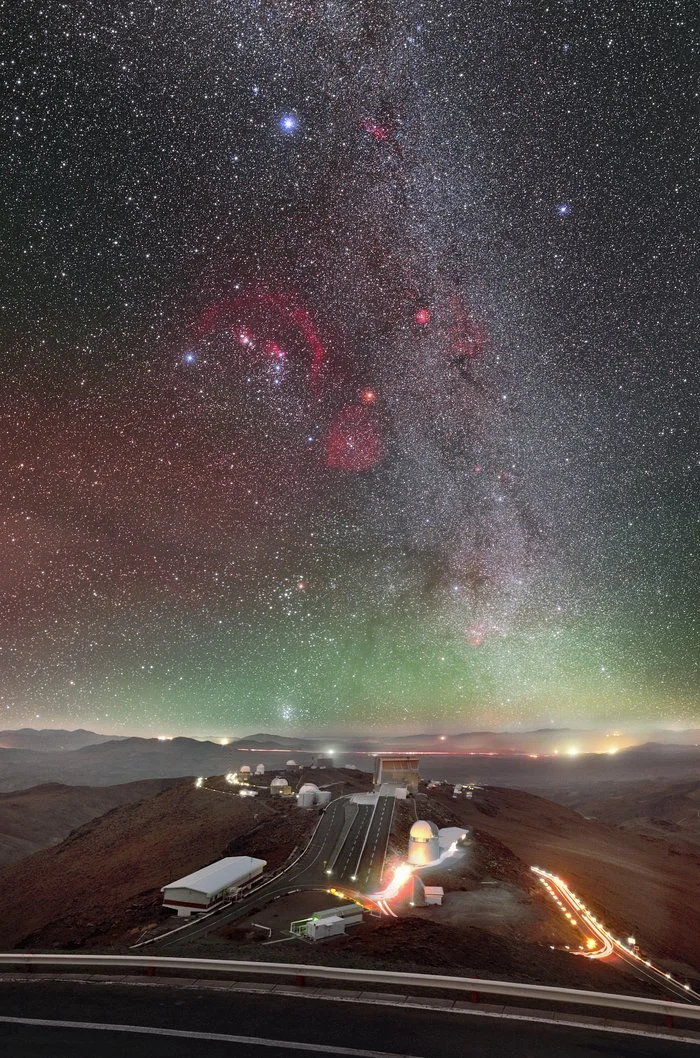
This stunning long-exposure photograph by ESO Photo Ambassador Petr Horálek captures the hive of activity at ESO’s La Silla Observatory, the distant glow of roads and settlements in the Atacama Desert, and the unmissable faint green radiance of airglow. https://www.eso.org/public/images/potw1922a/
Originally posted on Twitter.
This is where the Mars 2020 Rover is heading. From this picture, I think you can guess why.
Jezero Crater is an ancient lake that formed inside an impact crater. Detailed study of the features of the lake led scientists to conclude that the lake is ancient and did not experience times when water went down. Due to its long lifespan as a lake, it’s possible that life may have developed in the lake. It’s possible, though not necessarily likely, that preserved signs of life are waiting to be discovered at Jezero Crater.
Originally posted on Twitter.
NASA is building up a map of the entire sky seen in X-rays, line by line with its NICER experiment.
In this image, numerous sweeping arcs seem to congregate at various bright regions. You may wonder: What is being shown? Air traffic routes? Information moving around the global internet? Magnetic fields looping across active areas on the Sun?
In fact, this is a map of the entire sky in X-rays recorded by NASA's Neutron star Interior Composition Explorer (NICER), a payload on the International Space Station.
https://www.eurekalert.org/pub_releases/2019-05/nsfc-nnm053019.php
Originally posted on Twitter.
I curse the proof banner - but I adore the shiny.💖
Time for one more read-through!
P.S.: Yes, the barcode mashup is also due to it being a proof copy. 🤨
Originally posted on Facebook.
An abundance of boulders litters the surface of asteroid 101955 Bennu in this dramatic close-up from the OSIRIS-REx spacecraft. Taken on March 28 from a distance of just 3.4 kilometers (2.1 miles) the field of view is about 50 meters across while the light colored boulder at top right is 4.8 meters tall. https://apod.nasa.gov/apod/ap190524.html
Incredible to think about, isn’t it?
Originally posted on Twitter.
A New “Star Wars” Movie Based On “Knights Of The Old Republic” Is In The Works https://www.buzzfeednews.com/article/kateaurthur/new-star-wars-movie-knights-of-the-old-republic?bftwnews
The KOTOR games are the most unique, original, evocative storytelling in the Star Wars universe, so let the hype begin :).
Originally posted on Twitter.